Friday, August 3, 2012

The World Map, Olympic Style

I was inspired by the blow up world globe I have hanging up in my house. The children come visit me and after knocking it around for awhile ask, what is this? It’s like a map of the world, on a balloon, I tell them. I taught a little girl the continents and show most people where Panama and the United States are, because – to my disbelief- they are unaware of their relative location on the planet. The mountains, lush jungle, and gravel road in and out of our community are all they know and all they've needed.


With the summer Olympic Games going on in London, I decided to paint a world map at the school in my community and include lesions in social studies about geography and the Olympic Games. We talked about what the games are, what the events are, and who participates. We highlighted Panamanian Olympic long jump gold medalists Irving Saladino. Then the kids practiced their own long jump! Using the map we could identify the countries participating in certain events – nearly the entire world coming together in competition no matter the size, wealth, or history of the country… or athletes. We’ll track the medal results throughout the games keeping a close proud eye on our panama friends. When I was a little girl I dreamed about being an Olympic gymnast and I hope the children felt inspired to dream about goals for themselves as well!

Here is photo documentation of the painting process, as well as the activity in the school.


Saturday, July 28, 2012

Washing Feet

I occasionally accompany some families from my community to their church on Saturdays, the Adventists church in the next town over. I like connecting with them on the religious level and don't shy away from it like some volunteers do in order to stay as neutral as possible. As far as I'm concerned, spirituality is human nature and the spirituality of an indigenous Central American group of people can be analyzed in a fascinating way. The religions of western missionaries sometimes is awkwardly insisted in their culture and sometimes it is nicely blended.

Last Saturday communion was celebrated with a foot washing beforehand. I've seen this done before in America, a reproduction of the last supper, Jesus' act of service and humility. But in America - we remove our clean shoes and clean, if not a little sweaty socks, to reveal and wash freshly showered feet. Probably some occurences of  fungus but for someone not phobic to feet there is nothing to fear. But here? People rarely wear real shoes. Floors to homes are dirt, roads are dirt, sidewalks of concrete don't exist to make even paths. People are clean here, they are pridefully clean. They bathe and wash clothes regularly. But feet? In this environment, they get dirty. A friend recently asked me a "would you rather..." question involving Ngobe toes and something equally gross.

I pondered from a distance the foot washing proceedings and the symbology and new literal meaning to me. Some parts of western religion are awkward among a non western culture - but some, like the foot washing example of Jesus, fit better.


Friday, July 13, 2012

Music and Lit Review

Calle 13 "Entran Los Que Quieren"


This Puerto Rican alternative rock group is big in the Latin music scene right now, for good reason. Unique alternative sounds meet Latin vocals in a mix between rap and spoken word with rebellious anarchical lyrical themes. The songs are of varying styles, sprinkled with strings and horns and electrical beats, and classic Latin guitar best exemplified in "Baile de Los Pobres". The album has a quirky intro and outro that shows off their alternative style. This is good music. Check it out.

Gone Girl by Gillian Flynn


This book ran me through the gamut of reaction based emotions. A thriller and mystery, with relationship themes that subscribe to both genders, it's not a girly book but I think the title would defer men. The twisted plot follows husband and wife Nick and Amy through Amy's sudden disappearance and Nick's attempts to investigate and avoid a curious amount of damning evidence pinned to him by the police and media. I think I both loved and hated Nick and Amy at various points, a clear good-guy not even possible. It was satisfying and hooking. Read this instead of 50 Shades of Grey.

Ngabere

Nisqually, Puyallup, Shi shi, Skokomish, Samish, Skagit.

To anyone outside the Pacific Northwest corner of the US that sentence might seem like gibberish, a list of made up words. Of course those are locations in Washington with names indigenous to the Americans native there. Although the native languages of tribes in America are nearly lost (you don't hear it spoken by shoppers at the grocery store) we are reminded of it by the names of cities, towns, and rivers.

Nantori deka. Ma toa no? Ti toa kuin. Ma ka no? Ti ka Belligo.

Another line of gibberish? Or another indigenous language? Now you're catching on. Ngabere (nah-bare-ee), the language of the people group Ngabe (nah-beh), is very alive and spoken frequently in traditional communities here in Panama. I live in one of these traditional communities, for this reason during my first week living there I was given the indigenous name "Belligo" (beh-ji-go). 

Ngabere has only recently been a written language. There only exist a few books, mostly from the church, in Ngabere. A Ngabe man left his community to study in the city and decided to write a manual for learning to speak Ngabere. This man is employed by Peace Corps Panama to train volunteers in the language. A few weeks ago I attended a class with him to improve my Nagbere skills.

Mostly I communicate in Spanish in my work here. People speak Spanish in my community, but it is the second language for most people over the age of 20. I am constantly encourage to become fluent in Ngabere. This would be the ultimate in cultural assimilation. I will always use Spanish as my main form of communication, while Ngabere is more for entertainment purposes (for them to laugh at me trying to speak it). It is a tough language to learn, being non-Latin and barely written. The seminar I attended helped greatly. Having a patient and slow speaking teacher, practicing pronunciation and common phrases. Mostly I use Ngabere to have small conversations about basic things and mostly with people I meet walking around. For example.

Person passing on trail: nantori deka.
Me: nantori deka!
Person: ma niki madende?
Me: Ti niki sede (with a hand wave). Ti niki basare.
Person. Oh, ma niki basare. Ma sribiri nede?
Me: Jah. Ti sribiri nede, ti nune duimate. Ti sribiri cuerpo de paz ben.
Person: Kuin. Jahtwida pues.
Me. Jahtwida mare.

Translation? Good afternoon, good afternoon. Where are you going? Over there to hang out. Do you work here? Yes, I work here and I live in Duima. I work for the Peace Corps. Good. Goodbye then. See you later.

I'm glad I am learning fluency in Spanish, but this is cool too. I don't know if it's a resume worth skill, maybe just a party trick, but certainly another unique cultural experience!

Sunday, June 3, 2012

SoƱadora

When I am in my community, the person inside my head is my only English speaking companion. This is to whom I express my most complicated thoughts to - the ones that don't translate well. Read this article about why daydreaming isn't a waste of time. Replace "kids" with "Peace Corps volunteer" for a better understanding. Then replace it with your name. Maybe some time alone with yourself would be good for you, too.

Tuesday, May 22, 2012

Oh My Mangoes!

As soon as the first drops of rain began to hit the parched earth at the start of the rainy season the clumps of green mangoes hanging from the gigantic crooked limb'd mango trees decided collectively it was time to ripen. Since then, mangoes fall like candy from heaven on the ground everywhere. The variety and number of mangoes could be compared to wild apples in Washington state.

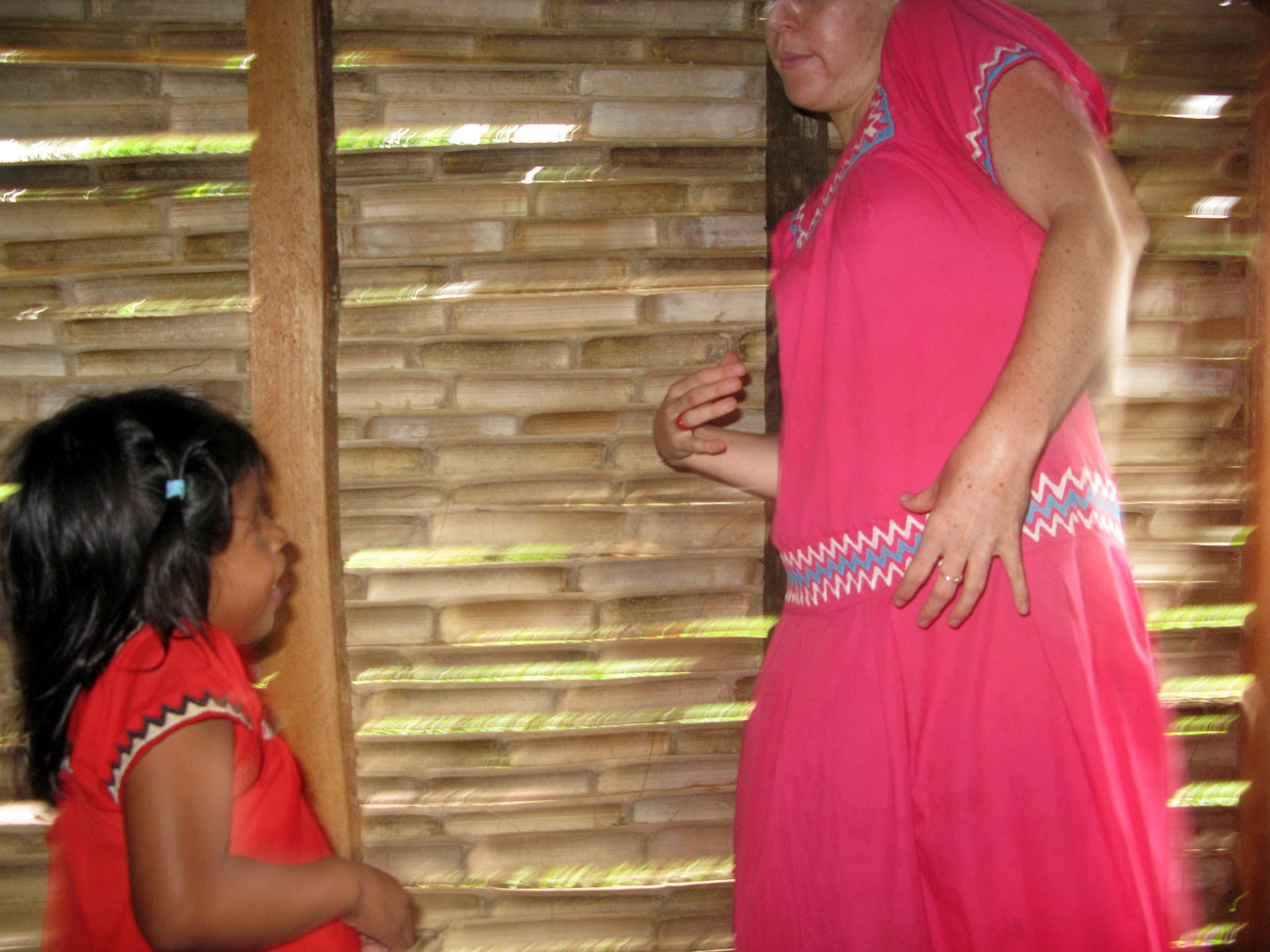
One rainy afternoon I stashed myself away in my house, door closed, sitting in my hammock reading. It was clear I was not accepting visitors at that moment, so when two of my favorite little girls knocked on my door I hesitatingly got up. Little did I know the gifts they brought hung in the dresses like baskets. Mangoes!

"Girls...", I asked in a serious tone, "Do you think we could eat so many mangoes our stomachs would explode?" 


Then we did the second best thing to do on a rainy afternoon. Dance. 


Chicha Libre


I love this article I found on NPR's music page. The "corn-derived liqueur" is the same my indigenous people consume. This spunky music is fun and "harmonizes" with how one feels after a few cups of chicha!

A Brooklyn band with musicians from three continents, Chicha Libre has just released its second album, Canibalismo.