Sunday, May 12, 2013

Oh My Gosh, Shoes

Most kids (and some adults!) that I run around with in the mountains don't wear shoes. Shoes are expensive, kids loose them. It's easier to kick a wet soccer ball in the rain with bare feet than sandals. Parents just can't keep shoes on their squirrely kids' little feet, if they try at all. 

Shoes are an important part of heath when you live in an area where there are no floors, only dirt and grass. Chickens run free and even if you try you can't totally avoid animal feces. Parasites like hookworm are evolved specifically to enter a host through bare feet. Hookworm is found in feces of cats, dogs, and humans and and travel up to five feet in any direction while looking for a host. Tiny, blood sucking hookworms can cause anemia and growth retardation in children and infants of infected mothers with no symptoms

This is not a blog post promoting Toms Shoes, but they do a pretty good thing. If you're not familiar, Toms Shoes is a company that makes stylish but basic shoes for people in America to purchase. The company charges a price that includes the cost of a second pair of shoes and has promised, for every pair bought, to use part of the profits to make and send a pair of shoes to a developing country. 

I've known plenty of people who proudly stride around in Toms Shoes, with an air of righteousness because they not only look good,  but save lives too. Skeptically I've wondered who gets the promised shoes, where, and what is their effective rate of use. 

Well, folks, I've finally seen Toms in the wild. I found this little girl and she shyly allowed me to photograph her. I pleasantly wonder who has the matching pair of shoes in the US, and I think they should be happy with themselves. 


Sunday, April 21, 2013

Balsaria


I love indigenous festivals. Being there I can wonder at the people celebrating and the traditions that may be centuries old. People are proud and loud. They're having fun, doing their thing, welcoming me in to see. 

Seriously, time to fight.
Balsaria is a traditional festival for the Ngäbe indigenous people. The term Balsaria comes from the word for the balsa tree. Large sticks made from balsa wood are used to fight, turns taken throwing at the legs of another man. The two fighters will face each other, dancing around to gain the best shot at avoiding or throwing. Traditionally the fights occur between representatives from community groups and the prize... get this... is the other man's woman. That's right, they fight for wives. 

The battlefield

The scene for Balsaria looks like this: a large field filled with people standing around individual fights. The perimeter of the field is women serving soup and the beloved liquid courage, fermented corn beverage chicha. Spontaneous refereed fist fights break out among the most drunk men. Men wear naguas, the traditional dress for women, along with hats decorated with feathers and colorful fabric, and dead stuffed animals slung on their backs. There is a noise being constantly emitted that can be heard a mile away, like something from a World Cup soccer match. Cow horns, turtle shells, and shells from the beach are blows to make the ruckus. 

             
     I found this hipster with fake glasses


Just a jaguar, no big deal
Making some noise
Being thrown at
Throwing the balsa stick. Note man in dress with dead animal on back.

Life can be rough for 
Ngäbes here in the mountains. It's either scalding hot or pouring down rain. Sometimes you cow falls into a hole and your crops won't grow. Well, this is the once a year celebration to proudly be a Ngäbe - a true man - who can carry twice what you can, up hill, for twice as long. And he'll beat you up to prove it.

Look at more photos here.

Monday, April 8, 2013

Solar Pump Aqueduct Project

You know those TV commercials where they use a innocent, poor, adorable child to pull at your heart strings and donate to a cause? This blog post will be one of those... 

Sergio, fill my water buckets? 
My friend and fellow Peace Corps volunteer Serigo lives in a community named Guyabo far north in the province of Cocle. The people who live there are not indigenous (they don't wear traditional dresses or speak anything but Spanish) but are considered camposinos which means, literally, country people. To arrive in Guyabo, you must ride in the back of a truck from town for around an hour. When the truck lets you off, walk down the muddiest road you have ever seen for just over another hour. If live wasn't hard enough for the people of this community, every day everyone must collect water from one bored well in town. Collecting water mean tossing a bucket with a rope down a 50 foot shaft, letting it fill, then pulling it up by hand. Or... sending your cute-as-button daughter on a horse with buckets to the well and waiting until the she calls from atop the horse to coax the Peace Corps volunteer in town to fill them for you. But there must be a better way! 

Sergio, walking home in the mud.
Sergio and his community have a dream to build a water distribution system in the community. Using a pump powered by solar panels, the water would fill a tank located above the community. From there, a distribution system will deliver water to every house in the community. Imagine, running water in your house for the first time in your life. 

The existing well

Sergio designed the system, the solar panels and pump are in place, the community is poised to do the labor, but the funding for the materials for the tank and the distribution system are still needed. Would you consider partnering with Sergio and Guyabo to realize this project? You can click below to find out more and to donate. 


Thanks!

Sergio and I have been kickin' it since the beginning!


Friday, April 5, 2013

Revolution


The Guna Yala is an indigenous comarca (reservation) on the north eastern coast of Panama. The Guna people have a fascinating history, including one of the only successful revolutions by indigenous people from invading colonizers. They are a fiercely proud people, though small in stature. Their societal organization is impressive and their location unmatched on scattered islands in the crystal blue water of the Caribbean. They keep their comarca fairly restricted to outsiders, the only Panamanian institutions are schools and hospitals. 


In February, a group of volunteers and I hiked and joined the celebration that marked the revolution of the Guna people. The trip started with a two-day hike though the dense jungle and across the mountain range that protects the Caribbean Ocean. 

It was a dirty, bloody battle of a hike but when we arrived at the Caribbean at dusk of the second day a glorious feeling swept over all of us.


We took a boat to the island capital and slept. The celebration included a dramatization of the revolution itself, a parade, and a chicha-drinking-dance party.  Everyone wore red. The Guna people use the swastika as their symbol (not just a Nazi emblem). 


My very brave friend Sarah (right) joined us from the US for a cannonball jump into not only Guna culture, but Peace Corps life as well. 


The tradition of drinking fermented coffee and cacao chicha commenced in one large hut. Men danced and yelled in rows of six before being handed bowls of chicha to drink. The women, in more free form style, danced and smoked cigarettes and took shots of chicha. It was impolite to refuse or share a beverage that was offered to you, so of course we were obliged to partake... 


This was one of my favorite and most memorable experiences here in Panama. For all of my photos from the trip, click here


Thursday, February 14, 2013

Jumping Rope


Do you remember what it's like to jump rope for the first time? 

I gave some kids a jump rope and a little instruction and let them go for it. The results were hilarious and entertaining and super-duper cute. Good times were had by all. 


It was also Peace Corps Volunteer Chet's first time to jump rope...


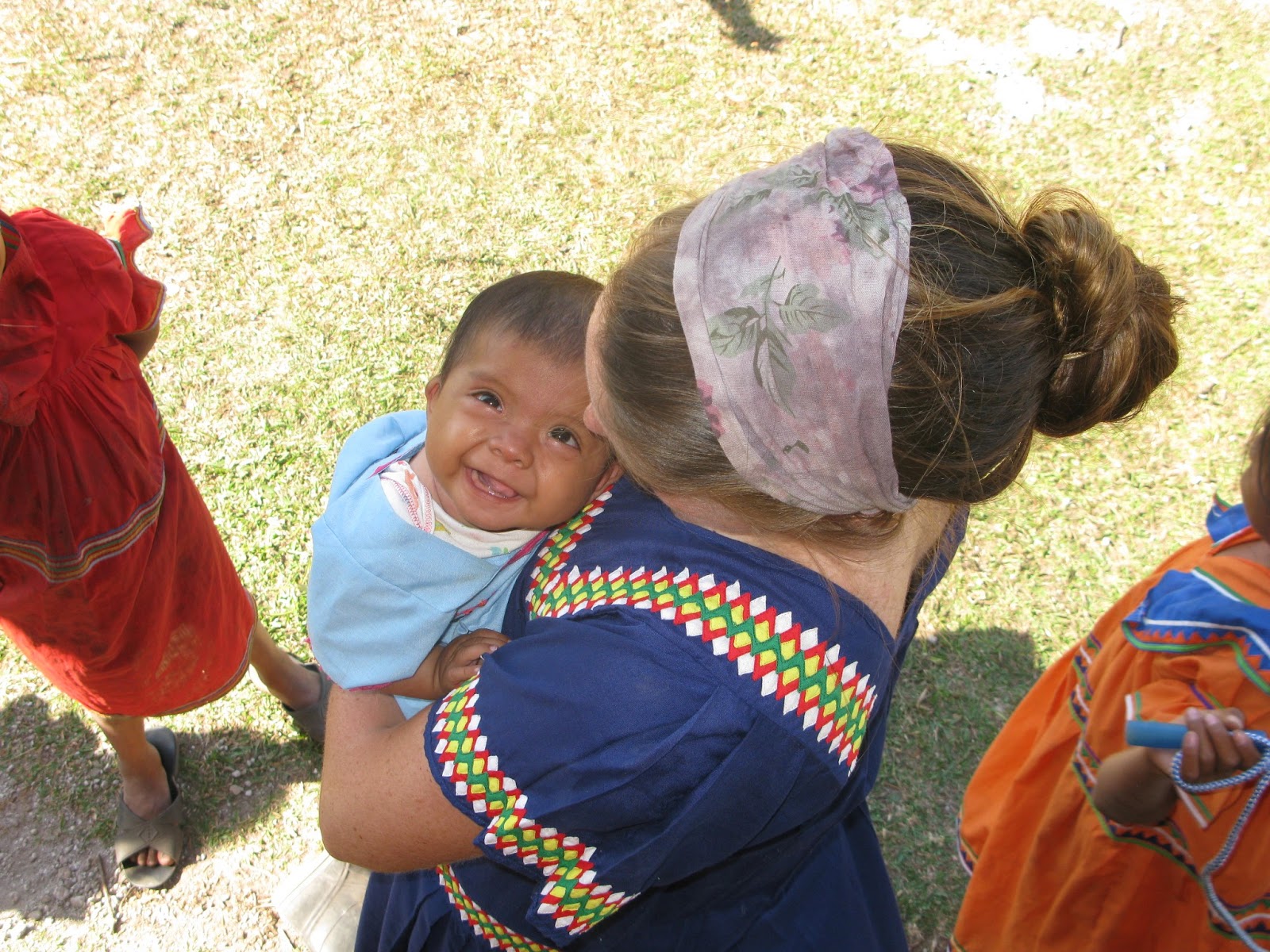
And then I found a baby.


Friday, February 1, 2013

How do you get to school?

Five miles, in the snow, uphill... both ways? 

Try an Indiana Jones-style bridge crossing. 


This decrepit bridge spans a major river which flows swiftly in the rainy season. The community just above the bridge is home to the only 9th, 10th, and 12th grade high school within many miles, as well as an elementary school. Kids regularly cross this bridge or risk the river forge swelled by afternoon rains during the school year. 


Last year concerned parents took the issue to Panama's main highway to draw the attention of the government. The government responded with a placating attempt at starting to build a new bridge, but now the project has been left abandoned for nearly six months. 

This brave soul, Ezekiel, allowed me to video him crossing the bridge. 


Saturday, November 24, 2012

El Dia de Accion de Gracias: Thanksgiving

Thanksgiving one year ago was different than ever before. I don't mean in what I did - because I'm certain that every single Thanksgiving Day of my life I've done something unique, in keeping with tradition. Last year I was more appreciative of small things that I've ever been. Hot water, clean toes, etc. 

This year, I'm still appreciative, but less in the wide eyed, shell shocked at civilization, give me as much food you can sort of way, and more in the I totally appreciate my life, my friends, and what I've been given the opportunity to do sort of way. 

I met 150 of my closest Peace Corps Volunteer friends at a small rustic mountain eco-resort above the farming town of Cerro Punta. It was beautiful... and cold. I mean cold. OK, it wasn't snowing, but I wanted to put on a jacket like never before here in Panama.  It rained and we socialized and snuggled beneath multiple layers in our beds at night. I used the sauna with my friends. There was an amazing group of volunteers who cooked a fabulous real American Thanksgiving dinner. What was hard to come by (sweet potatoes??) was substituted (squash) and made delicious. Satisfied, but our stomachs not too full to slow anyone down, we did the night Latin (or Peace Corps) style with dancing. 


Photo Credits: Bri Drake